Like most other regions in the world, science and technology in Korea has experienced periods of intense growth as well as long periods of stagnation.
Archaeological evidence from Gosan-ri in Jeju-do indicates that pottery was first made c. 8500-8000 BC. People depended on gathering, hunting, and fishing as the main source of food until the Middle Jeulmun Period (c. 3500 to 2000 BC) when small-scale cultivation of plants began.
Farmers of the Mumun Period began to use multiple cropping systems of agriculture some time after 1500 BC. This sophisticated technological advance in food production irrevocably altered the subsistence systems of the Mumun and hastened the beginnings of intensive agriculture in the Korean Peninsula. Korea and adjacent areas of East Asia seem to have been a part of the domestication region of soybean (Glycine max) between 1500 and 500 BC.Paddy-field agriculture, a highly complex system of wet-rice cultivation, was also introduced into the southern Korean Peninsula during this period.
Widespread archaeological evidence shows that after 850 BC the technology for heating homes changed. Before 850 BC pit-houses were heated using fire from various kinds of hearths that were dug into the floor of the pit-house. After 850 BC, hearths disappeared from the interior of pit-house architecture and was likely replaced with some kind of brazier-like technology in Hoseo, Honam, and western Yeongnam.
Bronze objects were exchanged into the Korean Peninsula from the outside before 900 BC. However, the moulds for bronze casting from Songguk-ri and an increased number of bronze artifacts indicates that people in the southern part of the peninsula engaged in bronze metallurgical production starting from c. 700 BC. Several hundred years later iron production was adopted, and Korean-made iron tools and weaponry became increasingly common after approximately 200 BC. Iron tools facilitated the spread of intensive agriculture into new areas of the Korean Peninsula.
Until recently, Koreans were thought to have invented under-floor heating, a system they call "ondol". It was first thought to have been invented by the people of North Okjeo (modern-day Russia's maritime province) around 2,500 years ago. However, the recent discovery of a c. 3,000 year-old equivalent indoor heating system in Alaska has called current explanation into question. The absence of prehistoric and/or ancient ondol features in the area between the two archaeological sites makes it unlikely that the two systems might have come from the same source.

 The production of hard-fired stoneware ceramics, in which clay is vitrified in kilns at >1000°C, occurred first in the Korean Peninsula during the Three Kingdoms Period.
This period is notable for the establishment of industrial-scale production of pottery and roof tiles. This involved the adoption of climbing kiln or 'dragon kiln' technology sometime between AD 100-300.
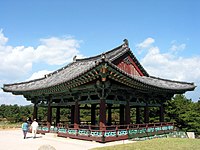
One of very few examples of science and technology during the Three Kingdoms of Korea that has survived until this day is the Cheomseongdae, which means "star gazing platform" and is one of the oldest observatories installed on Earth. It was built during Queen Seondeok's rule. The tower is built out of 366 pieces of cut granite which some claim represent the 366 days of the lunar year and has 12 base stones which supposedly represent the twelve months of the year. The design is said to be strongly influenced by Buddhism.
The nine-story wooden pagoda of Hwangnyongsa, which was commissioned by Queen Seondeok after the main temple was finished, is reputed to be the largest premodern Korean stupa ever built. It was reported to be 80 metres in height. Only its foundation stones remain today but they attest to the mammoth proportions of the original structure.
 The Joseon Dynasty under the reign of Sejong the Great was Korea's greatest period of scientific advancement. Under Sejong's new policy that allowed Cheonmin (low-status) people such as Jang Yeong-sil
to work for the government. Jang is one of Korea's most famous
inventors. When he was very young he built machines to help make
worker's jobs easier such as aqueducts, canals among others. Jang
eventually was allowed to live at the royal palace where he led a group
of scientists to work on advancing Korea's science.
The Joseon Dynasty under the reign of Sejong the Great was Korea's greatest period of scientific advancement. Under Sejong's new policy that allowed Cheonmin (low-status) people such as Jang Yeong-sil
to work for the government. Jang is one of Korea's most famous
inventors. When he was very young he built machines to help make
worker's jobs easier such as aqueducts, canals among others. Jang
eventually was allowed to live at the royal palace where he led a group
of scientists to work on advancing Korea's science.
Some of his inventions were an automated (self-striking) water clock, the Jagyeokru which worked by activating motions of wooden figures to indicate time visually was invented in 1434 by Jang Yeong-sil, who later developed a more complicated water-clock with additional astronomical devices, as well as an improved model of the previous metal movable printing type created in the Goryeo Dynasty. The new model was of even higher quality and was twice as fast. Other inventions were the sight glass, and the udometer.
Also during the Joseon Dynasty Heo Jun, a court physician wrote a number of medical texts, but his most significant achievement is Dongeui Bogam, which is often noted as the defining text of Traditional Korean medicine. The work spread to China and Japan, where it is still regarded as one of the classics of Oriental medicine today.
The highpoint of Korean astronomy was during the Joseon period, where men such as Jang created celestial globes which could, whether day or night, allow the instrument to be updated on the positions of the sun, moon, and the stars among other devices Later celestial globes (Gyupyo, 규표) could measure time changes according to the seasonal variations.
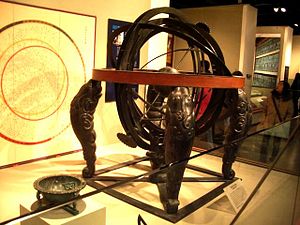
The apex of astronomical and calendarial advances made under King Sejong was the Chiljeongsan, made up of compiled computations on the courses of the seven heavenly objects (five visible planets, the sun, and moon) developed in 1442. This work made it possible for scientists to calculate and accurately predict all the major heavenly phenomena, such as solar eclipses and other stellar movements. Honcheonsigye is an astronomical clock created by Song I-yeong in 1669. The clock has an armillary sphere with a diameter of 40 cm. The sphere is activated by a working clock mechanism, showing the position of the universe at any given time.
Kangnido, a Korean made map of the world was created in 1402, by Kim Sa-hyeong (김사형, 金士衡), Yi Mu (이무, 李茂) and Yi Hoe (이회, 李撓). The map was created in the second year of the reign of Taejong of Joseon. The map was made by combining Korean and Chinese maps.
Hangul, the first and only featural alphabet in current use for a national language, was promulgated by Sejong in 1444.
 Scientific and technological development in the South Korea at first
did not occur largely because of more pressing matters such as the division of Korea and the Korean War that occurred right after its independence. It wasn't until the 1960s under the dictatorship of Park Chung-hee where South Korea's economy rapidly grew from industrialisation and the Chaebol corporations such as Samsung and LG.
Scientific and technological development in the South Korea at first
did not occur largely because of more pressing matters such as the division of Korea and the Korean War that occurred right after its independence. It wasn't until the 1960s under the dictatorship of Park Chung-hee where South Korea's economy rapidly grew from industrialisation and the Chaebol corporations such as Samsung and LG.
As of 2008 South Korea ranked 5th highest in terms of R&D. Park Kye-jung, CEO of Ace Electronics, won the Gold and Silver prizes for his invention of motor and motor-equipped gear at the 23rd Invention and New Product Exposition, he took the gold medal with his invention of a special device that converts vibrations from a running car into electric power. During the INPEX held in Pittsburgh, Pennsylvania sixteen Korean inventions received awards, including four gold prizes, three silvers, three bronzes and six special prizes. The Pittsburgh INPEX had inventors from 20 countries, contenders from Australia, Germany, the United States and 11 other countries submitted 160 items.
Seoul is ranked as the world's "leading digital city" and a "tech capital of the world" South Korea is also among the world's most technologically advanced and digitally-connected countries; it has the third most broadband Internet users among the OECD countries and is a global leader in electronics, digital displays, semiconductor devices, and mobile phones.
Formally disgraced scientist, Hwang Woo-suk led a bio-engineering team that created three living clones of a dog that died in 2002.
Korea also exports radioactive isotope production equipment for medical and industrial use to countries such as Russia, Japan, Turkey and others.
Korea has a full-fledged space partnership with Russia and has launched the Arirang-1 and Arirang-2 which both have surveillance cameras equipped.
In robotics, KAIST competes with the Japanese company Honda with its humanoid robot HUBO. Honda's ASIMO and KAIST's HUBO lines are the two of very few humanoid robots that can walk. The first HUBO was developed within a span of 3 years and cost 1 million USD.
In renewable energy, South Korean scientists at the Gwangju Institute of Science and Technology in cooperation with the University of California, Santa Barbara successfully developed an organic photovoltaic power cell with energy efficiency of 6.5 percent.
Prehistory
At the end of the Palaeolithic, people of the Korean Peninsula adopted microlithic stone tool technology, a highly efficient and useful way of making and maintaining a flexible prehistoric toolkit. The Palaeolithic also marks the beginning of a long period of plant and human interaction in which people undoubtedly adopted a number of wild plants for medicinal use.Archaeological evidence from Gosan-ri in Jeju-do indicates that pottery was first made c. 8500-8000 BC. People depended on gathering, hunting, and fishing as the main source of food until the Middle Jeulmun Period (c. 3500 to 2000 BC) when small-scale cultivation of plants began.
Farmers of the Mumun Period began to use multiple cropping systems of agriculture some time after 1500 BC. This sophisticated technological advance in food production irrevocably altered the subsistence systems of the Mumun and hastened the beginnings of intensive agriculture in the Korean Peninsula. Korea and adjacent areas of East Asia seem to have been a part of the domestication region of soybean (Glycine max) between 1500 and 500 BC.Paddy-field agriculture, a highly complex system of wet-rice cultivation, was also introduced into the southern Korean Peninsula during this period.
Widespread archaeological evidence shows that after 850 BC the technology for heating homes changed. Before 850 BC pit-houses were heated using fire from various kinds of hearths that were dug into the floor of the pit-house. After 850 BC, hearths disappeared from the interior of pit-house architecture and was likely replaced with some kind of brazier-like technology in Hoseo, Honam, and western Yeongnam.
Bronze objects were exchanged into the Korean Peninsula from the outside before 900 BC. However, the moulds for bronze casting from Songguk-ri and an increased number of bronze artifacts indicates that people in the southern part of the peninsula engaged in bronze metallurgical production starting from c. 700 BC. Several hundred years later iron production was adopted, and Korean-made iron tools and weaponry became increasingly common after approximately 200 BC. Iron tools facilitated the spread of intensive agriculture into new areas of the Korean Peninsula.
Until recently, Koreans were thought to have invented under-floor heating, a system they call "ondol". It was first thought to have been invented by the people of North Okjeo (modern-day Russia's maritime province) around 2,500 years ago. However, the recent discovery of a c. 3,000 year-old equivalent indoor heating system in Alaska has called current explanation into question. The absence of prehistoric and/or ancient ondol features in the area between the two archaeological sites makes it unlikely that the two systems might have come from the same source.
Three Kingdoms Period

 The production of hard-fired stoneware ceramics, in which clay is vitrified in kilns at >1000°C, occurred first in the Korean Peninsula during the Three Kingdoms Period.
This period is notable for the establishment of industrial-scale production of pottery and roof tiles. This involved the adoption of climbing kiln or 'dragon kiln' technology sometime between AD 100-300.
One of very few examples of science and technology during the Three Kingdoms of Korea that has survived until this day is the Cheomseongdae, which means "star gazing platform" and is one of the oldest observatories installed on Earth. It was built during Queen Seondeok's rule. The tower is built out of 366 pieces of cut granite which some claim represent the 366 days of the lunar year and has 12 base stones which supposedly represent the twelve months of the year. The design is said to be strongly influenced by Buddhism.
The nine-story wooden pagoda of Hwangnyongsa, which was commissioned by Queen Seondeok after the main temple was finished, is reputed to be the largest premodern Korean stupa ever built. It was reported to be 80 metres in height. Only its foundation stones remain today but they attest to the mammoth proportions of the original structure.
Joseon Dynasty

 The Joseon Dynasty under the reign of Sejong the Great was Korea's greatest period of scientific advancement. Under Sejong's new policy that allowed Cheonmin (low-status) people such as Jang Yeong-sil
to work for the government. Jang is one of Korea's most famous
inventors. When he was very young he built machines to help make
worker's jobs easier such as aqueducts, canals among others. Jang
eventually was allowed to live at the royal palace where he led a group
of scientists to work on advancing Korea's science.
The Joseon Dynasty under the reign of Sejong the Great was Korea's greatest period of scientific advancement. Under Sejong's new policy that allowed Cheonmin (low-status) people such as Jang Yeong-sil
to work for the government. Jang is one of Korea's most famous
inventors. When he was very young he built machines to help make
worker's jobs easier such as aqueducts, canals among others. Jang
eventually was allowed to live at the royal palace where he led a group
of scientists to work on advancing Korea's science.Some of his inventions were an automated (self-striking) water clock, the Jagyeokru which worked by activating motions of wooden figures to indicate time visually was invented in 1434 by Jang Yeong-sil, who later developed a more complicated water-clock with additional astronomical devices, as well as an improved model of the previous metal movable printing type created in the Goryeo Dynasty. The new model was of even higher quality and was twice as fast. Other inventions were the sight glass, and the udometer.
Also during the Joseon Dynasty Heo Jun, a court physician wrote a number of medical texts, but his most significant achievement is Dongeui Bogam, which is often noted as the defining text of Traditional Korean medicine. The work spread to China and Japan, where it is still regarded as one of the classics of Oriental medicine today.
The highpoint of Korean astronomy was during the Joseon period, where men such as Jang created celestial globes which could, whether day or night, allow the instrument to be updated on the positions of the sun, moon, and the stars among other devices Later celestial globes (Gyupyo, 규표) could measure time changes according to the seasonal variations.
The apex of astronomical and calendarial advances made under King Sejong was the Chiljeongsan, made up of compiled computations on the courses of the seven heavenly objects (five visible planets, the sun, and moon) developed in 1442. This work made it possible for scientists to calculate and accurately predict all the major heavenly phenomena, such as solar eclipses and other stellar movements. Honcheonsigye is an astronomical clock created by Song I-yeong in 1669. The clock has an armillary sphere with a diameter of 40 cm. The sphere is activated by a working clock mechanism, showing the position of the universe at any given time.
Kangnido, a Korean made map of the world was created in 1402, by Kim Sa-hyeong (김사형, 金士衡), Yi Mu (이무, 李茂) and Yi Hoe (이회, 李撓). The map was created in the second year of the reign of Taejong of Joseon. The map was made by combining Korean and Chinese maps.
Hangul, the first and only featural alphabet in current use for a national language, was promulgated by Sejong in 1444.
Modern period
South Korea


As of 2008 South Korea ranked 5th highest in terms of R&D. Park Kye-jung, CEO of Ace Electronics, won the Gold and Silver prizes for his invention of motor and motor-equipped gear at the 23rd Invention and New Product Exposition, he took the gold medal with his invention of a special device that converts vibrations from a running car into electric power. During the INPEX held in Pittsburgh, Pennsylvania sixteen Korean inventions received awards, including four gold prizes, three silvers, three bronzes and six special prizes. The Pittsburgh INPEX had inventors from 20 countries, contenders from Australia, Germany, the United States and 11 other countries submitted 160 items.
Seoul is ranked as the world's "leading digital city" and a "tech capital of the world" South Korea is also among the world's most technologically advanced and digitally-connected countries; it has the third most broadband Internet users among the OECD countries and is a global leader in electronics, digital displays, semiconductor devices, and mobile phones.
Formally disgraced scientist, Hwang Woo-suk led a bio-engineering team that created three living clones of a dog that died in 2002.
Korea also exports radioactive isotope production equipment for medical and industrial use to countries such as Russia, Japan, Turkey and others.
Korea has a full-fledged space partnership with Russia and has launched the Arirang-1 and Arirang-2 which both have surveillance cameras equipped.
In robotics, KAIST competes with the Japanese company Honda with its humanoid robot HUBO. Honda's ASIMO and KAIST's HUBO lines are the two of very few humanoid robots that can walk. The first HUBO was developed within a span of 3 years and cost 1 million USD.
In renewable energy, South Korean scientists at the Gwangju Institute of Science and Technology in cooperation with the University of California, Santa Barbara successfully developed an organic photovoltaic power cell with energy efficiency of 6.5 percent.